Atomic Bats
Ystlumod Atomig
A new project by Seán Vicary, co-produced by Animate Projects, in partnership with Oriel Davies, Newtown, Atomic Bats will explore the experience of living in a time of climate crisis and mass-extinction, refracted through an exploration of a particular place and landscape – the Rhydymwyn Valley in North Wales.
In 1940, the German Jewish scientist Rudolf Peierls and his assistant Klaus Fuchs, furthering their research at the University of Birmingham, established themselves in Building P6 at the Rhydymwyn Valley Works in North Wales, to supervise the production of Uranium 235, the isotope used in the Hiroshima nuclear bomb. Atomic Bats will reveal and share this history, and how it informs and resonates with what this place means for people living there now.
This in turn acts as a point of departure to explore notions of interconnectedness and interdependence, in collaboration with ecological philosopher Timothy Morton.
Bronwen Lloyd Jones, former vocalist in the seminal anarcho-punk band Crass, will contribute spoken word and vocal improvisation to the soundtrack.
Atomic Bats will have its premiere exhibition at Oriel Davies Gallery in Autumn 2026, and then tour to venues across Wales and in England.
Atomic Bats is supported by Arts Council of Wales and Arts Council England.
Seán was selected for Parts & Labour, the second Animate OPEN exhibition at QUAD, Derby, in 2016, which toured to Oriel Davies. We also previously worked with him on Lament (2011), and Re-Tolled (2013) for Channel 4’s Random Acts.
Seán is based in Cardigan, West Wales. He works across moving image, animation and digital media, exploring ideas at the heart of our relationships with place, landscape, and the ‘natural’ world, revealing links between subjective, scientific and social histories, and our lives today. He has exhibited in Wales, the UK, and internationally. He won the Gold Medal for Fine Art at the National Eisteddfod of Wales in 2022.
Timothy Morton is Rita Shea Guffey Chair in English at Rice University, Houston. They have collaborated with Björk, Laurie Anderson, Adam McKay, Olafur Eliasson, Jennifer Walshe and Ben Rivers. Morton co-wrote and appears in Living in the Future’s Past, a 2018 film about global warming with Jeff Bridges. They have written over 20 books, including Hyperobjects, The Ecological Thought and Dark Ecology. Their latest book Hell: in Search of a Christian Ecology was published in June 2024.
Musician and artist Bronwen Lloyd Jones AKA Eve Libertine was co-lead vocalist in the seminal anarcho-punk band Crass. She has continued to develop her visceral, vocal experimentation through performance and recording. Her latest album ‘I am that Tempest’ was released via Caliban Sounds in July 2024.
Oriel Davies, Newtown was founded 1982 and is a key public art gallery of Wales, based in Newtown, rural Powys, presenting thought-provoking and challenging art by national and international artists.
Prosiect newydd gan Seán Vicary, a gyd-gynhyrchwyd gan Animate Projects, mewn partneriaeth ag Oriel Davies, Y Drenewydd, bydd Ystlumod Atomig yn archwilio’r profiad o fyw mewn cyfnod o argyfwng hinsawdd a difodiant torfol, wedi’i blygu trwy archwiliad o le a thirwedd arbennig – yng Nghwm Rhydymwyn yng Ngogledd Cymru.
Ym 1940, sefydlodd y gwyddonydd Iddewig Almaeneg Rudolf Peierls a’i gynorthwyydd Klaus Fuchs eu hunain yn Adeilad P6 yng Ngwaith Cwm Rhydymwyn yng Ngogledd Cymru i oruchwylio cynhyrchu Wraniwm 235, yr isotop a ddefnyddiwyd yn fom niwclear Hiroshima. Bydd Ystlumod Atomig yn datgelu ac yn rhannu’r hanes hwn, a sut mae’n llywio ac yn atseinio beth mae’r lle hwn yn ei olygu i bobl sy’n byw yno nawr.
Mae hyn yn ei dro yn gweithredu fel pwynt ymadael i archwilio syniadau o ryng-gysylltedd a chyd-ddibyniaeth, mewn cydweithrediad â’r athronydd ecolegol Timothy Morton. Bydd Bronwen Lloyd Jones, cyn-leisydd y band anarcho-pync arloesol Crass, yn cyfrannu at y gair llafar a byrfyfyr lleisiol i’r trac sain.
Bydd Ystlumod Atomig yn cael ei harddangosfa gyntaf yn Oriel Davies yn hydref 2025, ac yna’n teithio i leoliadau ledled Cymru a Lloegr.
Cefnogir Ystlumod Atomig gan Gyngor Celfyddydau Cymru a Arts Council England.
Dewiswyd Seán ar gyfer Parts & Labour, yr ail arddangosfa Animate OPEN yn QUAD, Derby, yn 2016, a aeth ar daith i Oriel Davies. Buom hefyd yn gweithio gydag ef yn flaenorol ar Lament (2011), a Re-Tolled (2013) ar gyfer Random Acts Channel 4.
Mae Seán wedi ei leoli yn Aberteifi, Gorllewin Cymru. Mae’n gweithio ar draws delweddau symudol, animeiddio a chyfryngau digidol, gan archwilio syniadau sydd wrth wraidd ein perthynas â lle, tirwedd, a’r byd ‘naturiol’, gan ddatgelu cysylltiadau rhwng hanesion goddrychol, gwyddonol a chymdeithasol, a’n bywydau heddiw. Mae wedi arddangos yng Nghymru, y DU, ac yn rhyngwladol. Enillodd Fedal Aur Celfyddyd Gain yn Eisteddfod Genedlaethol Cymru 2022.
Timothy Morton yw Cadair Rita Shea Guffey mewn Saesneg ym Mhrifysgol Rice, Houston. Maent wedi cydweithio â Björk, Laurie Anderson, Adam McKay, Olafur Eliasson, Jennifer Walshe a Ben Rivers. Cyd-hysgrifennodd ac ymddangosodd Morton yn Living in the Future’s Past, ffilm 2018 am gynhesu byd-eang gyda Jeff Bridges. Maent wedi ysgrifennu dros 20 o lyfrau, gan gynnwys Hyperobjects, The Ecological Thought a Dark Ecology. Cyhoeddwyd eu llyfr diweddaraf Hell: in Search of a Christian Ecology ym mis Mehefin 2024.
Bu’r cerddor a’r artist Bronwen Lloyd Jones AKA Eve Libertine yn gyd-brif leisydd y band anarcho-pync arloesol Crass. Parhawyd i ddatblygu ei harbrofion gweledol, lleisiol trwy berfformio a recordio. Rhyddhawyd ei halbwm diweddaraf ‘I am that Tempest’ trwy Caliban Sounds ym mis Gorffennaf 2024.
Mae Oriel Davies yn oriel gelf gyhoeddus allweddol yng Nghymru, wedi’i lleoli yn Drenewydd, Powys wledig. Cyflwynir celf o safon fyd-eang, sy’n procio’r meddwl ac yn heriol gan artistiaid cenedlaethol a rhyngwladol.
December 2025: update from Seán
Seán is in production and has been making many visits to Rhydymwyn over the last year. We talked to him about the place, history, and resonance.
You’ve been visiting Rhydymwyn Valley a lot over the last few months. But how did you come to find this particular place?
It was during the COVID lockdown. When you’re stuck inside, and can’t go outside, it’s quite nice to think about when you’ll be able to go outside and what you would like to do. So, I was looking for something that I could work on setting up; I had lots of ideas I wanted to explore and people I felt like I wanted to work with, and I was looking for a place that might have a resonance with that.
I was thinking of places I knew, in Pembrokeshire and Ceredigion, but I stumbled upon Rhydymwyn via Subterránea Britannica, and then found the Rhydymwyn Valley History Society website.
The more I read about the place and the more I went through online; looking at photographs and reading the history; the more it resonated on multiple levels.
It pushed so many buttons that made me excited and I thought ‘this is a serendipitous gift that I should take.’
What is it about the place that fascinates you?
It’s brought together a whole swathe of interests but when I eventually went there, between lockdowns, the first impression was that it’s incredibly eerie. I like Mark Fisher’s definition of the eerie – he talks about it being a failure of presence or a failure of absence. Something is there, when there should be nothing. Or nothing is there when there really should be something. Rhydymwyn does both those things, and sometimes it does them at the same time. The feeling you have when you’re standing there or working there is very, very strange because of that.
It was also its importance as part of the Second World War.
My uncle worked at Austin’s Longbridge plant and was killed in 1940 during the Birmingham Blitz. My father was born in 1918 and was due to go to art school in London, but he joined up and was trained to run a mobile radar unit on the Pembrokeshire coast. He never talked about the war or his brother, and it was always a very no-go area. You could feel it. But he would take us traipsing around these desolate military buildings and things on the South Coast and places in Wales; and he’d make prints of them – quite eerie things.
Also, I trained as a painter, and liked those neo-romantic, pre-war/post-war painters – John Piper, Ivon Hitchens, Paul Nash, Graham Sutherland – they have that quality too.
It’s strange how you can stand in the middle of the obvious and not notice… how all that must have shaped the way that I look at certain things.
I’ve always been a huge science fiction fan as well, especially that slanted ecological science fiction like Nigel Kneale and John Wyndham, and those adaptions of the late ’60s, early ’70s – stuff that gets classed as ‘hauntology’ these days. It’s almost seen as an expression of the failure of the postwar dream – this wonderful postwar optimism that slowly sours, and that’s how you end up with the children’s television that I grew up with, like Alan Garner’s The Owl Service and Children of the Stones – these very disturbing TV series.
So Rhydymwyn touches all those things for me.
And how does all this connect with the ecological themes that you’re exploring?
The site embodies that as well. A lot of those TV series – like Quatermass – were set in weird places, with their secret research – like Rhydymywn – and often with an ecological, apocalyptic bent. This was a mustard gas factory with an additional history of atomic research. Part of the world’s first nuclear weapons research programme was set up there (codename Tube Alloys); this was so secret that even the people working on site producing mustard gas didn’t know about the uranium enrichment experiments happening in Building 45.
Rudolf Peierls and Klaus Fuchs who were leading the nuclear research at Rhydymwyn, would eventually go to join the Manhattan project and work on the Trinity test in Los Alamos – and Trinity was the beginning of nuclear weapons testing which has left a radioactive signature worldwide – this global deposit is of one of the key things international stratigraphers have cited in their search for a ‘Golden Spike’ marking the start of the Anthropocene as a distinct geological era[i]. So Rhydymwyn has a direct link to this – and how that resonates today.
What about the site, today?
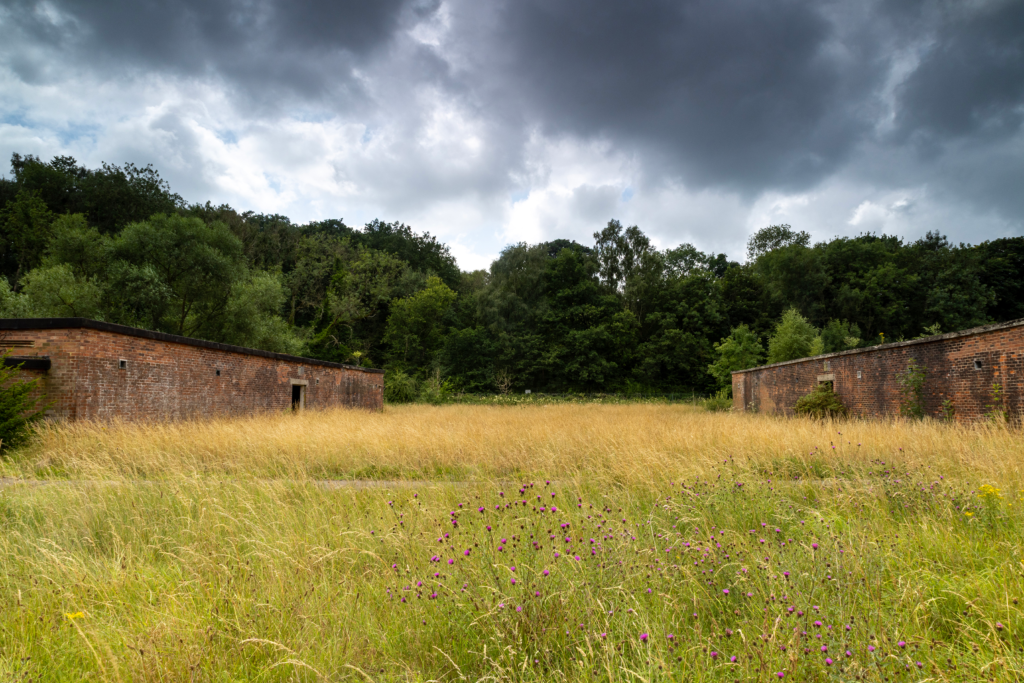
After being decommissioned in the early 1990’s, it was monitored and used as various things, but it was all still fairly secret. It wasn’t until 2003 that remediation work took place and they decided to knock some of the buildings down, which involved dealing with a lot of contaminated ground from the mustard gas factory. There was a plan to cover the whole site with concrete, 86 acres of it, a mile and a half long down the whole of the valley floor. But that was prohibitively expensive, and there was also an argument that there was something interesting, inherently special about the site and remaining buildings. It was decided to ‘plant’ for this option and turn the site into a nature reserve, while the 4 Mustard Gas production buildings received a Grade II listing and 21 others were designated ‘Scheduled Monuments’ by Cadw.
[i] “The sharpest chemostratigraphic signal so far identified is from artificial radionuclides such as plutonium and isotopes of caesium, americium etc. (Waters et al., 2015), which appeared on Earth as a result of the nuclear weapons testing programme, and dispersed (together with ‘excess’ radiocarbon) regionally by above-ground atomic bomb detonations from 1945, and from 1952 globally by the more powerful thermonuclear (‘H-bomb’) tests. The relatively long-lived plutonium-239 isotope (detectable for ~100,000 years) is suggested as the primary marker for the Anthropocene.”
Formal proposal of the Anthropocene Working Group to the ICS (International Commission on Stratigraphy) Subcommission on Quaternary Stratigraphy – 31st October 2023
You have the valley now – a fantastic space full of flora and fauna, alongside all these buildings that are the remnants of an important industrial military complex, with direct links to the first nuclear weapons programme. Obviously, there’s a tension, a dissonance, in holding those two things together in one space.
It’s interesting to me because it isn’t a museum. The buildings decaying, just there, surrounded by the reserve. And contaminated land. Which resonates so much with our relationship to what we think of as the natural world, which is something that I’ve always made work about – but now, much more about what we think of as nature. When I made my film Lament (2012), I talked about land being shaped by generations of interaction, and how everything exists simultaneously on different time scales; that you have eight bee lifespans to one field mouse, 40 mouse lifespans to one human, and four human lifespans to one oak tree. The need to think beyond anthropocentrism, beyond the human.
That was the best I could articulate 14 years ago, and it was quite clumsy. Not that I’ve got any better! – but someone I wanted to work with was Timothy Morton, the ecological philosopher and writer. I read his book Dark Ecology in about 2016, in which he writes about the multiple, overlapping spatiotemporal life forms that make up an ecology in a biosphere. It was almost like coming home! So, I reached out to Tim during lockdown, and said, look at this place, look at this history, look at these things. Is this an interesting vehicle to explore ideas of what nature is and where we fit in it? And he said yes.
A nature reserve, on a former chemical weapons site, and an atomic research facility: these ideas and direct connections to what we think of as the Anthropocene. Humans as a geological force shaping the whole of the planet.
Tim has this idea of an ecological awakening being a bit like a film noir – so that the more you investigate ecology, the more you understand it, until you have this epiphany where you become ecologically aware. But at the same time, doing this detective work, you suddenly realise that you’re implicated in the plot and that you’re the perpetrator as well as the detective.
The site embodies all those things, and it’s impossible to be there, working, without thinking about them all because it’s everywhere, you’re surrounded, enveloped.
The idea of nature as something that we need to preserve, that’s bounded by a fence, that you go into. That we are custodians of this thing that must be looked after and protected within boundaries. As opposed to embracing the idea that we are actually part of ‘nature’. And it’s the kind of thinking that says we’re not part of nature which has led to the ecological catastrophe that we’re living through.
Where is this leading you to, in the work? What will we see? What and how are you animating?
Over the past few years, I’d developed a methodology and a practice that’s place-related. It feels a little naïve now: the thought that I could go and work in a place, on location. That the way to get to know a place was to subsume yourself, explore and take photographs, make field recordings, film and collect objects to animate. But I found that the more time you spend anywhere, the more you get to know it, the more you realise you don’t know it at all. No matter how much time you spend anywhere, then there’s an unknowability of it.
So, it’s coming to terms with that. Now I collect samples that I then work with in the studio, very consciously thinking that there’s some sympathetic magic that happens at a distance; a dialogue between place and studio, a call and response. Though, at Rhydymwyn you’re not allowed to take anything off-site, because it’s classed as contaminated and subject to restrictions. Consequently, I’ve spent time there cataloguing things and doing live-action and stills photography.
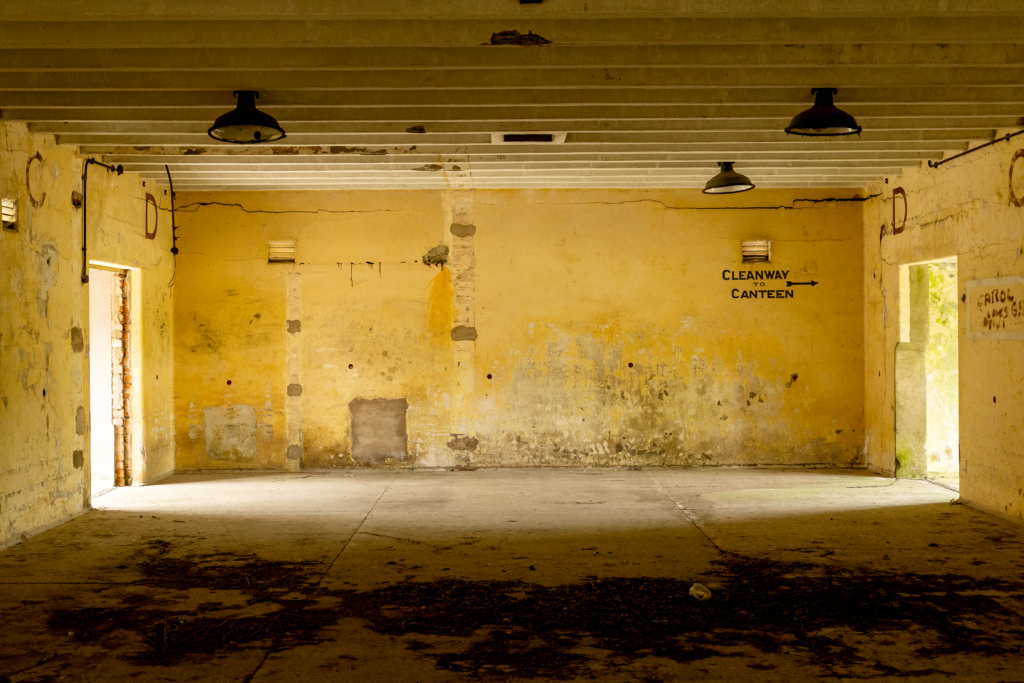
I am using some plant forms – and this is back to boundaries – because I can collect Rosebay willowherb from outside the boundary fence, just up the lane. My plans for the work are still developing, but it will be about making the invisible, visible. If there’s nothing present in those buildings, where there should be something; it’s giving form to that unseen presence.
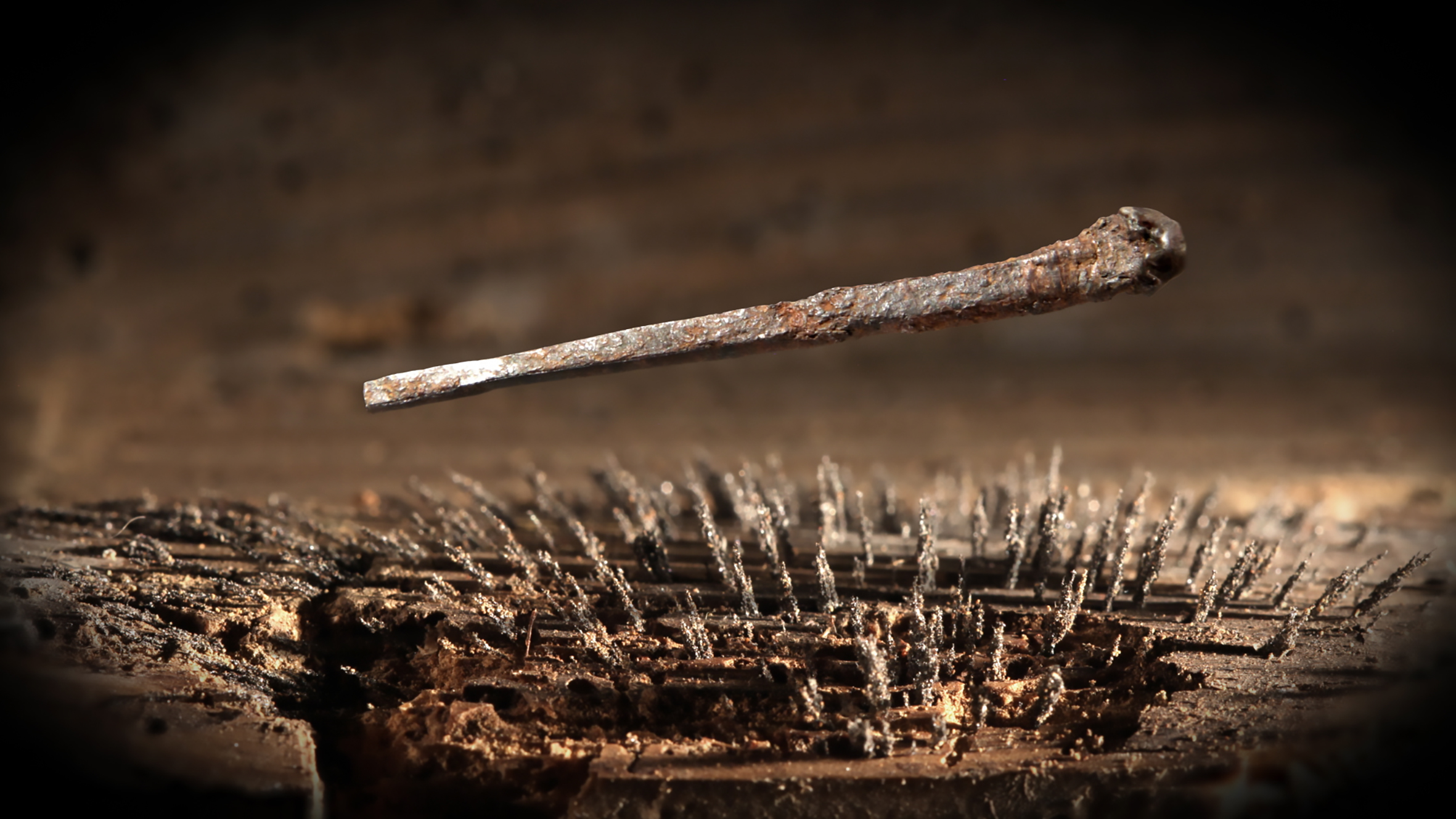
These buildings have no windows. Brambles and wild roses are growing into them, so the rigid line between inside and outside the buildings is very blurry. They’re being subsumed by the plant life and the bats – a whole colony in the building where the atomic research was done. I’ve been recording bat sounds with a bat expert and with an ecologist. Those boundaries feel permeable – back to the idea of nature not being something that’s ‘out there’.
How we live in symbiosis is something I wanted to explore. All the gut flora and bacteria that are part of our human biome. That symbiotic dependence, and the realisation that we ourselves are an ecological construct.
And then, radioactivity. One of the things I’m working with is a piece of trinitite – the glassy, radioactive residue that was left on the desert floor after the Trinity nuclear test. And I have a very small piece of that that I’ve been animating in the studio.
And what will we hear?
It will be a sound collage and a score – just as the various animations and live-action stuff is collaged together. I’ve made a lot of field recordings. And Tim and I have been having online conversations. talk. I’ve recorded other people working on the site – visitors, members of the History Society, the ecologist responsible for the nature reserve. There will be a text, that Bronwyn Lloyd Jones will perform.
At the moment, I’m assessing all that. It’s a mixture of people who use the site, who live there, who work there, and then people like Tim, who can articulate ideas that the site engenders, that the site brings into being, and thinking about the site in a wider context.
Image:
Sitelines, Seán Vicary
Winner of the Gold Medal for Fine Art at the 2022 National Eisteddfod
Enillydd y Fedal Aur am Gelfyddyd Gain yn Eisteddfod Genedlaethol 2022
Photos taken at Rhydymwyn, Seán Vicary