Roam
We are pleased to have worked with the campaigning organisation Right to Roam to support artists Edd Carr, Grace Lee and Sarah Silverwood to produce new animated films in response to their vision of “a future countryside in which people not only enjoy the physical, mental and spiritual benefits of nature but serve as its guardians too”.
The artists developed their films through a period of research, supported by discussions with Jon Moses and the team at Animate Projects. Their films reflect on themes of belonging, ancestry, enclosure, privatisation, colonial legacy, access islands, mysticism and witchcraft. These rich, mixed media animations have put environmental considerations and sustainability at the forefront of their techniques, and includes foraged wood, cyanotype made with boiled oak bark, oak gall ink painting on paper, film developed in oak tannin, and archival imagery.
Roam is our third commissioning programme aimed at early career animation artists. As with our previous projects PLANTING and Mortal, the Roam artists each received production and editorial support from Animate, Right to Roam and Fonic, as they developed and produced short, animated, single-screen films.
Touring events:
Roam will be touring this autumn, beginning with our partners at QUAD, Derby, for a screening and Q&A on 24 September 2026, 6pm. Here’s a list of upcoming screening events and links to book tickets:
- QUAD, Derby – 24 September, 6pm
- Grand Union – 5 October, 7pm
- Online Zoom webinar – 27 October, 1pm – click here to register
Edd Carr
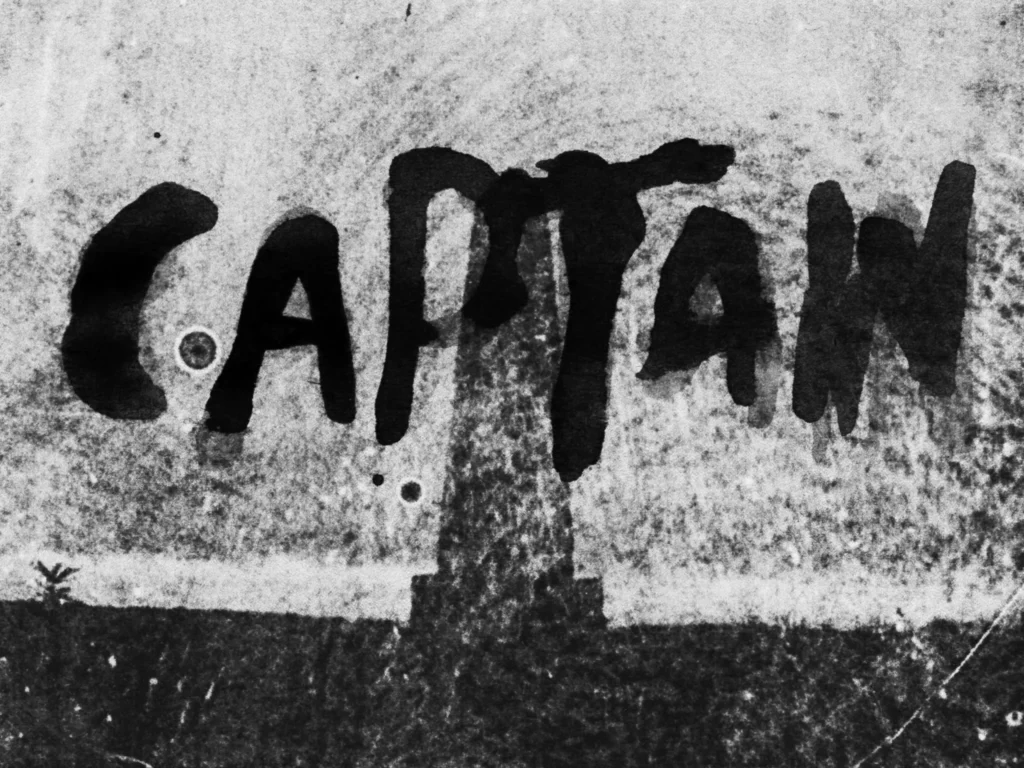
CAPTAIN COOK IS DEAD is an experimental animation that connects the history of colonial navigator Captain James Cook, his home region of the North York Moors (NYM), and the enclosure of common land to private land. The aim is to show how with the colonial practices of land seizure, British elites used a legal and rhetorical framework developed overseas to justify seizing common lands in England through the Enclosure Acts – including Captain Cook’s home of the NYM – a privatisation which still lingers today.
Through animating on oak materials foraged in the NYM, the film aims to connect this legacy to the living landscape. This includes animation on foraged oak wood and leaves, plus 8mm developed in oak bark extract, and oak toned prints. The title CAPTAIN COOK IS DEAD refers to the popular proclamation, ‘The king is dead, long live the king!’ in that Cook’s legacy of colonialism lives on in our ever-privatised natural spaces.
Edd Carr is an artist based in the UK. Adapting sustainable photographic processes into moving image – his work depicts our relationship to trauma and ecological crisis. Edd is also one of the leaders of the Sustainable Darkroom, the world’s first organisation dedicated to the research, development, and advocacy of eco-friendly alternatives to analogue and digital photography.
Sarah Silverwood
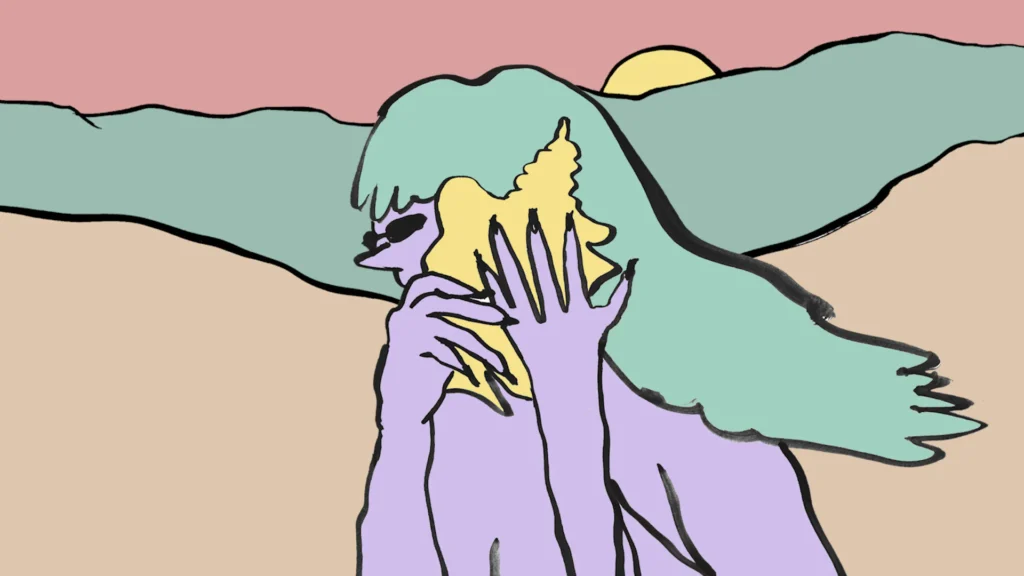
Clover is bored. Restless among manicured lawns and pristine hedges, she searches a map for somewhere different. Drawn to an irregular patch of land, she discovers a wildlife nirvana. She thrives in nature along with the older flora and fauna that exist there.
The film is inspired by the idea of ‘access islands’, areas of countryside surrounded by privatised land which makes them inaccessible, despite them being land we are legally allowed to access. These spaces often look different on a satellite map because of their lack of human intervention, remaining ‘unimproved’ land. In these forgotten landscapes, wildlife flourishes, while the mythologies of the land continue to bloom in otherworldly ways
Sarah Silverwood is an artist working across drawing, ceramics, animation and print. Her practice is all about playful storytelling, material experimentation and site-responsive design. Her cartoon worlds are full of psychedelic flora, stylish boots, amorphous rock forms, frantic figures and fast cars. Working across both gallery and public contexts, she creates artworks that are shaped by how people use and inhabit them. She is interested in the way stories become embedded within materials, and how thoughtful design can create opportunities for connection. Sarah’s drawing-centred approach combines careful research with an interest in materiality and craft.
https://www.sarahsilverwood.com/
Grace Lee
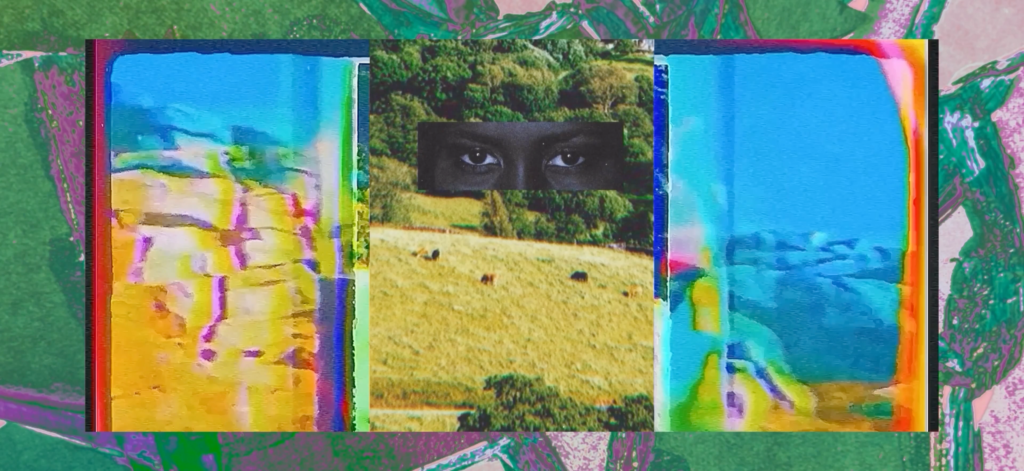
Ancestral Roaming is a hybrid collage animation exploring belonging, ancestry and the nervous system of ourselves and the land around us. A poetic roaming through England’s fenced landscapes, it explores how colonial legacies of land ownership and exclusion live within the body. Set within a shifting terrain of moorland, fences and unseen histories, the film follows a wanderer moving through exclusionary spaces. As they walk, the land itself awakens: roots shimmer beneath the soil, ancestral echoes hum in the air. Barbed wire softens into vines, maps dissolve, and the earth’s nervous system pulses back to life.
Through layers, collage and sound, the animation connects with nervous system healing with land justice, transforming the walk into a ritual of reclamation, resistance and sensory belonging.
Grace (SOME.GAL) is based in Sheffield. Her practice is rooted in hidden histories, ecology, diasporic memory and liberatory futures, working across animation, community collaboration and storytelling. She uses hybrid animation techniques, merging analogue processes, nature photography, archival materials and digital compositing to craft textured, layered visual worlds.Grace holds a degree in Anthropology and Sociology from Goldsmiths, University of London, and an MA in Scenography from the Royal Central School of Speech and Drama.
Roam Feedback Survey
Your feedback is really valuable to us in understanding more about the audience for our work. The data we collect through this survey is anonymous. Thank you for taking the time to give us your feedback.
Right to Roam
Since 2021, Right to Roam has been organising peaceful trespasses into some of the vast areas of countryside from which the public are currently excluded.
Led by botanists, ornithologists, astronomers, dancers, singers, citizen scientists, outdoors specialists and poets, Right to Roam follows the tried and tested access code which governs Scotland’s right of responsible access, respecting privacy, crops and nature – all while seeking to leave a positive trace and practising deep care for the natural world: a concept they call Wild Service.
Their vision is of a future countryside in which people not only enjoy the physical, mental and spiritual benefits of nature but serve as its guardians too.
https://www.righttoroam.org.uk/
Jon Moses
Jon is a writer and campaigner. He has published features, essays and profiles on environmental and other issues for The Guardian, Bloomberg Businessweek, The Lead, The Great Outdoors and in 2024 co-edited Right to Roam’s book, Wild Service: Why Nature Needs You.
He joined Right to Roam in 2021 after completing a doctorate in GeoHumanities and realising he knew almost nothing about where he actually lived.
A lengthy river trespass followed, and he’s never been the same since. At Right to Roam, Jon focuses on policy, communications and the ground campaign.